If you are comparing a plastic claw back scratcher with a heavier-duty alternative, the biggest differences usually come down to scratching pressure, durability, reach, and how much of your back the tool can actually cover.
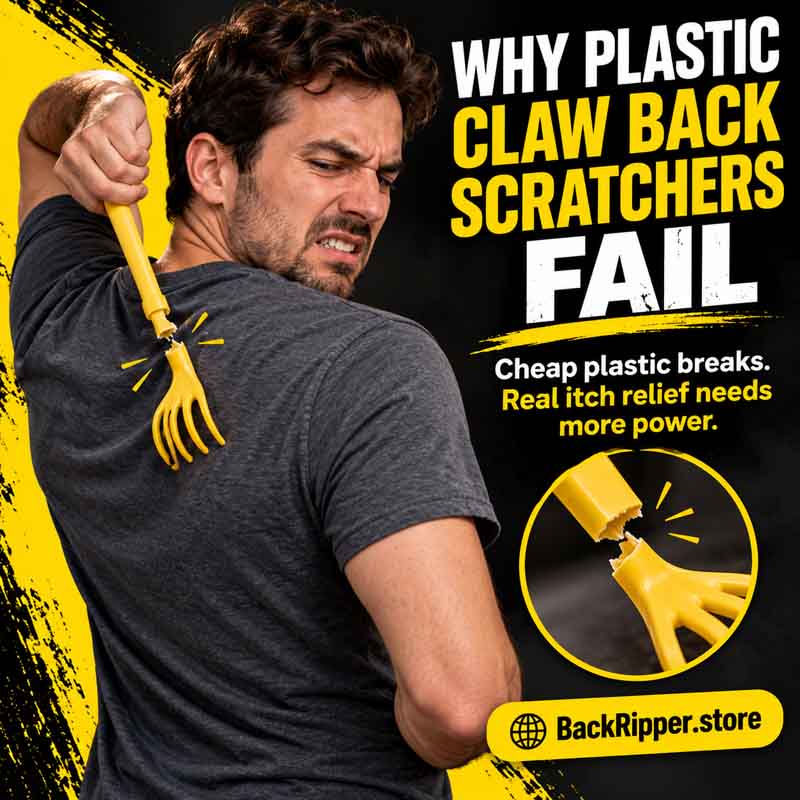
Plastic claw back scratchers are popular because they are inexpensive, lightweight, familiar, and easy to find. For a small occasional itch, they can work perfectly well. But people who want stronger scratching pressure or better coverage often find that a small plastic claw has limitations.
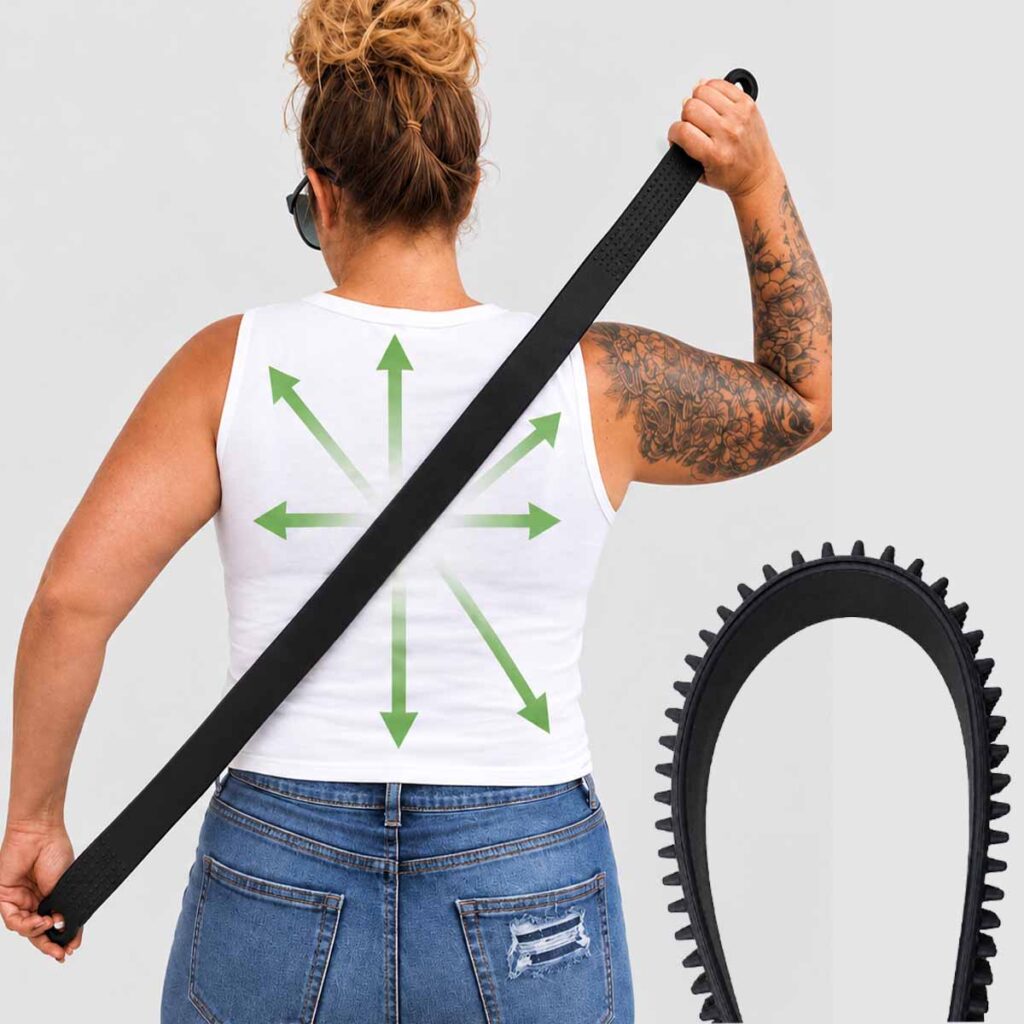
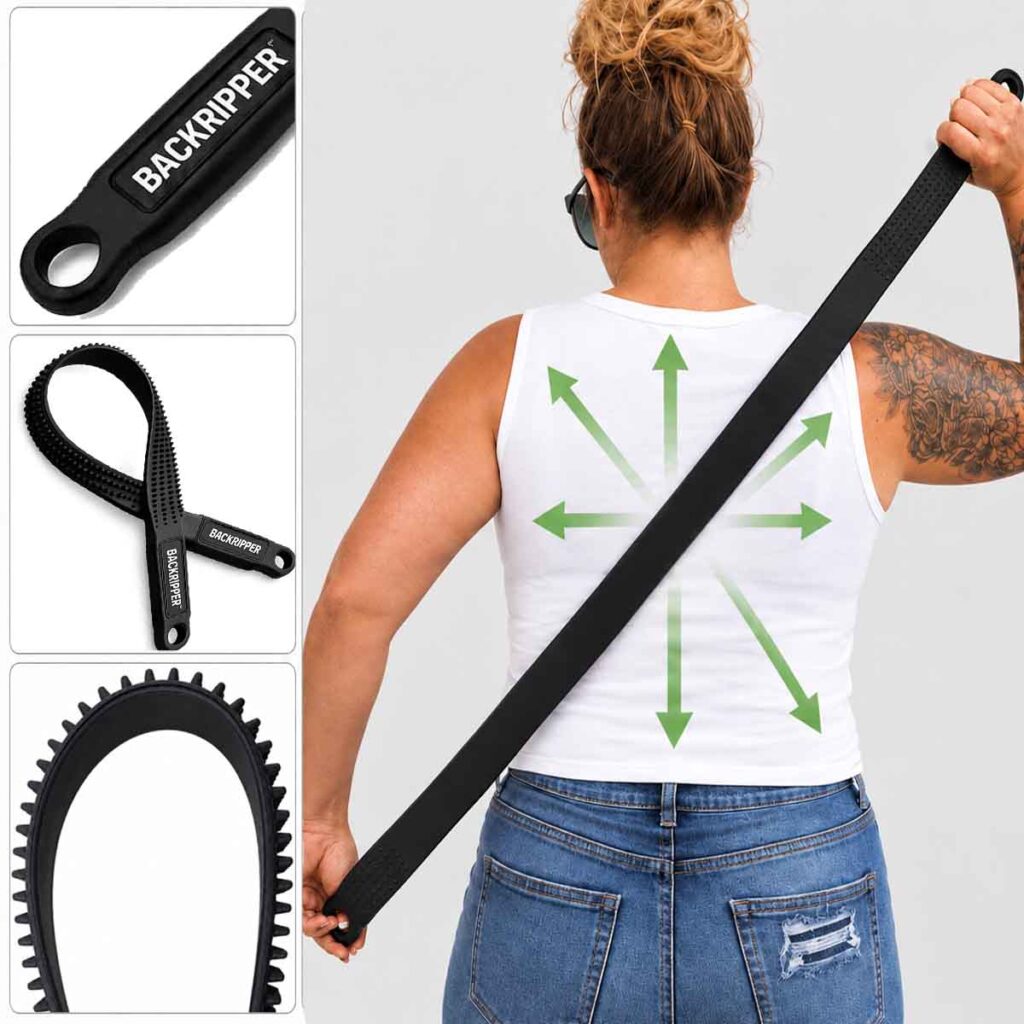
BackRipper™ was designed for people who want a different kind of scratching experience. Instead of using one small claw at the end of a rigid stick, BackRipper™ uses a flexible two-handed rubber strap with a large field of firm raised scratching knobs.
That difference in design changes how the tool feels, how much pressure you can apply, and how much of your back you can reach in a single movement.



What Is a Plastic Claw Back Scratcher?
A plastic claw back scratcher is one of the most common styles of back scratcher. It normally consists of a long handle with a small molded plastic hand or claw on the end.
The claw may have several fingers or points designed to imitate the sensation of fingernails. The long handle allows you to reach behind your body and target a specific area of the back.
This style has been around for years because it is simple and inexpensive.
A typical plastic back scratcher may be useful for:
- Quick occasional itching
- Small localized areas
- Light scratching pressure
- People who prefer a rigid handle
- Keeping a low-cost scratcher nearby
For many people, that is enough. But not everyone wants a light or localized scratch.
Why Are Plastic Claw Back Scratchers So Popular?
The biggest advantage of a plastic claw back scratcher is simplicity.
You pick it up, reach behind your back, and scratch the area that itches. There is very little learning curve, and inexpensive models are widely available.
They are also lightweight, which makes them easy to store in a drawer, vehicle, office, or bedside table.
Another reason they are popular is price. Plastic can be molded cheaply, so these products are often sold at relatively low prices.
For someone who only gets an occasional itch, paying a few dollars for a simple plastic claw may make complete sense.
The problem begins when a person wants more scratching pressure, better durability, or wider coverage.
Common Limitations of a Plastic Claw Back Scratcher
Not every plastic back scratcher has the same quality, but the basic design creates some common limitations.
Small Scratching Area
The scratching head on a plastic claw is usually fairly small. That can be useful when you know exactly where the itch is located, but it becomes less convenient when a large part of your back is itchy.
You may have to move the claw repeatedly across different areas rather than covering a large section in one stroke.
Limited Scratching Pressure
Some plastic claws are intentionally thin or flexible. Applying too much pressure can cause the claw or handle to bend.
For people who prefer a strong scratch, this can make the tool feel weaker than expected.
One-Handed Control
A traditional plastic back scratcher usually requires one hand to reach behind the body.
That works well for many people, but reaching the center of the back may require shoulder rotation and awkward wrist angles.
People with limited shoulder mobility may find some areas more difficult to reach comfortably.
Durability Varies
Plastic back scratchers range from very inexpensive lightweight models to stronger molded designs.
Thin plastic models can eventually bend, crack, or break, especially when people use more pressure than the product was designed to handle.
Plastic Claw Back Scratcher vs. BackRipper™
The biggest difference between a plastic claw back scratcher and BackRipper™ is not simply the material. It is the entire scratching method.
A traditional claw reaches your back from one point.
BackRipper™ wraps across the back and is controlled with both hands.
Instead of using a small scratching head, BackRipper™ has a much larger scratching surface containing many raised knobs.
This allows multiple contact points to move across the back at the same time.
If you want to compare several different styles of back scratchers, you can also see our guide to the best back scratchers and how the major designs differ.
Which Provides Stronger Scratching Pressure?
Scratching pressure is one of the most important differences between these designs.
With a plastic claw, pressure is controlled mainly by pushing the handle toward the body. The amount of usable force depends on the strength of the handle and claw.
With BackRipper™, you hold one end in each hand and pull the scratching surface against your back.
This allows you to control tension with both arms.
If you want a stronger scratch, you can increase tension. If you want less pressure, you can loosen the strap.
That makes a two-handed strap particularly useful for people who describe their preferred scratching sensation as strong, firm, aggressive, or deep.
If heavy scratching pressure is your main priority, you can also read our guide to choosing a heavy duty back scratcher.
Which Back Scratcher Covers More of Your Back?
A plastic claw is designed to target a relatively small spot.
BackRipper™ is designed to cover a much larger area.
Because the scratching surface stretches across the back, you can move it:
- Up and down
- Side to side
- Diagonally across the back
- Across the shoulder blades
- Across the middle back
- Across the lower back
This can be particularly useful when you cannot identify one exact itch because an entire section of your back feels irritated.
Instead of chasing one spot with a small claw, you can move across a larger area in a few strokes.
Which Design Is Easier for Hard-to-Reach Areas?
Both styles can reach areas your fingers cannot, but they do it differently.
A plastic claw extends one arm farther behind the body.
A two-handed strap approaches the problem from both sides.
By holding one handle in each hand, you can position the scratching surface across the middle of the back without needing to reach one arm directly over the exact spot.
That may make the design more comfortable for people who dislike twisting their shoulders or wrists behind themselves.
Plastic Back Scratcher vs. Flexible Rubber Back Scratcher
Material also changes the experience.
Rigid plastic is useful because it holds its shape. That makes it easy to direct a claw toward one specific itch.
Flexible rubber behaves differently. It can follow the natural curve of the body instead of remaining straight.
BackRipper™ combines flexibility with firm scratching points. The strap can bend around the body while the raised knobs remain firm enough to create noticeable scratching contact.
That combination is one reason a flexible strap can provide broader coverage while still allowing strong pressure.
Which Design Is More Durable?
Durability depends heavily on how a product is made.
A thick, well-made plastic scratcher may last a long time, while a very inexpensive thin plastic model may not.
BackRipper™ is made from heavy-duty flexible rubber and was designed to tolerate repeated bending and pulling during normal use.
Because there is no thin telescoping shaft or small plastic claw acting as the main pressure point, the design distributes force across a much larger section of the product.
That makes the construction fundamentally different from lightweight disposable-style scratchers.
Does a Stronger Back Scratcher Mean Sharper?
Not necessarily.
A back scratcher can provide strong scratching pressure without using dangerously sharp edges.
BackRipper™ uses numerous firm raised knobs rather than sharp metal points.
The sensation comes from controlled pressure and multiple contact points moving across the back.
The American Academy of Dermatology notes that repeated scratching can further irritate itchy skin, so any scratching tool should be used with reasonable pressure.
Start lightly and increase pressure only until the scratching sensation is comfortable.
Who Should Choose a Plastic Claw Back Scratcher?
A plastic claw back scratcher may be a good choice if you:
- Only experience occasional itching
- Prefer light scratching pressure
- Usually have one small itchy spot
- Want an inexpensive option
- Prefer a traditional rigid handle
- Want something small and simple
There is nothing inherently wrong with that design. For the right person, it can do exactly what is needed.
Who Should Choose BackRipper™?
BackRipper™ may make more sense if you:
- Prefer stronger scratching pressure
- Frequently experience back itching
- Want to cover a larger section of your back
- Have trouble reaching the middle or lower back
- Want two-handed control
- Are tired of thin or flimsy back scratchers
- Want a back scratcher designed for repeated use
BackRipper™ is particularly suited for people who want something that feels more substantial than the typical inexpensive plastic claw.
What About Telescoping Back Scratchers?
Telescoping back scratchers are another common alternative.
They can extend to reach difficult areas and collapse into a compact size for storage.
Some use metal claws while others use plastic scratching heads.
The main tradeoff is still scratching area. A telescoping design usually concentrates the scratch into one relatively small spot.
That can be ideal for a localized itch but less efficient when you want full-back coverage.
What If Your Back Is Constantly Itchy?
A back scratcher can temporarily relieve the sensation of itching, but it does not treat the underlying cause of persistent itching.
Dry skin, irritation, allergies, environmental conditions, and other causes can all contribute to itching.
The Mayo Clinic recommends medical evaluation when itching is severe, unexplained, lasts for an extended period, or occurs with other symptoms.
A scratching tool should be viewed as a way to provide temporary relief rather than a treatment for a medical condition.
Is BackRipper™ Better Than a Plastic Claw Back Scratcher?
That depends on what you want from a back scratcher.
A plastic claw has several real advantages. It is simple, inexpensive, lightweight, and good for targeting a specific small itch.
BackRipper™ is designed for a different type of user.
It provides a larger scratching surface, two-handed pressure control, broad back coverage, and a heavier-duty flexible design.
If your priority is the lowest possible price and occasional light scratching, a plastic claw may be enough.
If your priority is stronger scratching pressure, full-back coverage, and a tool designed for frequent use, BackRipper™ offers a very different experience.
A Different Approach to Back Scratching
The traditional plastic claw back scratcher has remained popular because it is simple and familiar.
But simple does not always mean ideal for every user.
BackRipper™ takes a completely different approach by replacing a small one-handed claw with a flexible two-handed scratching surface.
Instead of trying to reach one tiny spot at a time, you can pull the scratching surface across a much larger portion of your back while controlling the pressure yourself.
For people who frequently deal with hard-to-reach itching and want stronger scratching contact, that difference can matter.
To see detailed photos, product information, and current availability, visit the BackRipper™ product page.
BackRipper™ — The Back Scratcher That Actually Works.
What is a plastic claw back scratcher?
A plastic claw back scratcher usually has a long handle with a small molded hand or claw on the end. It is designed to reach itchy areas on the back with one hand.
Why do plastic claw back scratchers break?
Some plastic claw back scratchers are made from thin or lightweight plastic. Repeated bending or using strong scratching pressure can eventually cause the handle or claw to crack, bend, or break.
Is a plastic claw back scratcher good for strong itching?
A plastic claw can work well for a small localized itch, but people who prefer stronger scratching pressure or wider coverage may find the small claw and lightweight handle limiting.
What is the difference between BackRipper™ and a plastic claw back scratcher?
BackRipper™ uses a flexible two-handed rubber strap with many firm raised scratching knobs, while a plastic claw back scratcher uses one small scratching head on a rigid handle. BackRipper™ is designed for stronger pressure and broader back coverage.
Which back scratcher covers more of the back?
A flexible strap-style back scratcher can cover a much larger area than a small plastic claw. BackRipper™ can be moved up and down, side to side, or diagonally across the upper, middle, and lower back.
Is BackRipper™ better than a plastic claw back scratcher?
It depends on what you want. A plastic claw may be enough for occasional light itching, while BackRipper™ is better suited for people who want stronger scratching pressure, two-handed control, and full-back coverage.
Our Best Sellers
Looking for a back scratcher that actually works? Explore a few of our top picks, including the BackRipper™ Back Scratcher for strong, full-back coverage and other popular styles for different scratching preferences and budgets.
Shop These Back Scratching Options
-
BackRipper™ Back Scratcher Strap
Original price was: $29.99.$24.99Current price is: $24.99. -
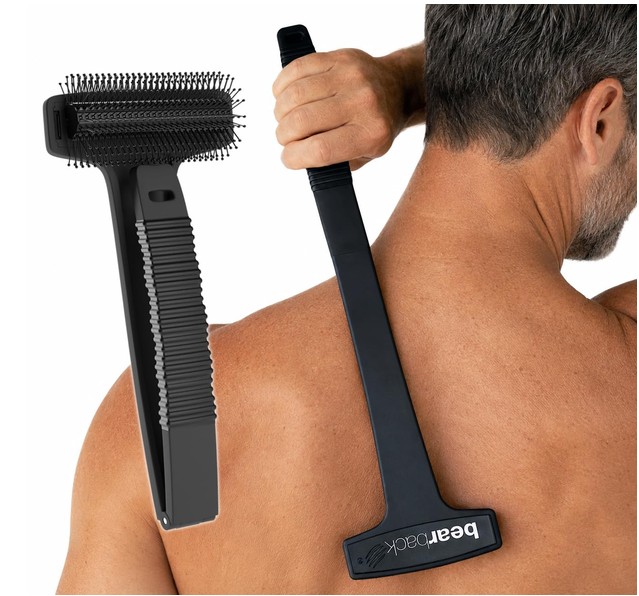
Nylon Bristle Back Scratcher
-
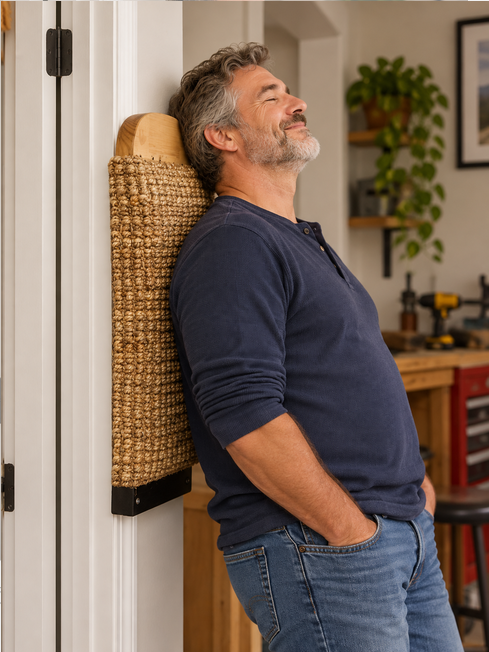
Wall Mounted Back Scratcher