
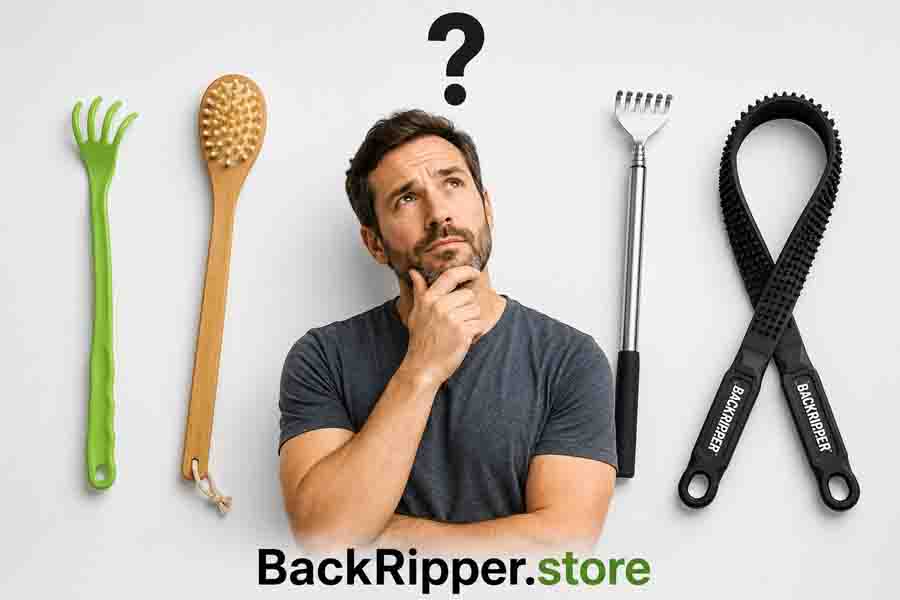
If you are trying to choose the best type of back scratcher, the answer depends on how strong you like the scratching pressure, where your back usually itches, how much reach you need, and whether you prefer a rigid tool or something that moves with your body.
Back scratchers come in several different styles, including plastic claw back scratchers, wooden and bamboo scratchers, telescoping models, brush-style scratchers, and flexible two-hand strap designs. Each type has advantages, but they can feel very different when you actually use them.
This guide compares the most common types of back scratchers so you can decide which design makes the most sense for your back.



What Is the Best Type of Back Scratcher?
The best type of back scratcher is the one that gives you enough reach, scratching pressure, comfort, and control for the way you actually use it.
Some people only need to reach one small itchy spot. Others want to scratch the entire middle or lower back. Some prefer a light touch, while others want a firm, aggressive scratching sensation.
The main types of back scratchers include:
- Plastic claw back scratchers
- Wooden or bamboo back scratchers
- Telescoping metal back scratchers
- Brush-style back scratchers
- Flexible strap or belt-style back scratchers
- Fingernail-style or multi-point back scratchers
If you want to compare individual products instead of general designs, see our guide to the best back scratchers.
Plastic Claw Back Scratchers
Plastic claw back scratchers are among the most familiar designs. They usually have a long handle with a small molded hand or claw on the end.
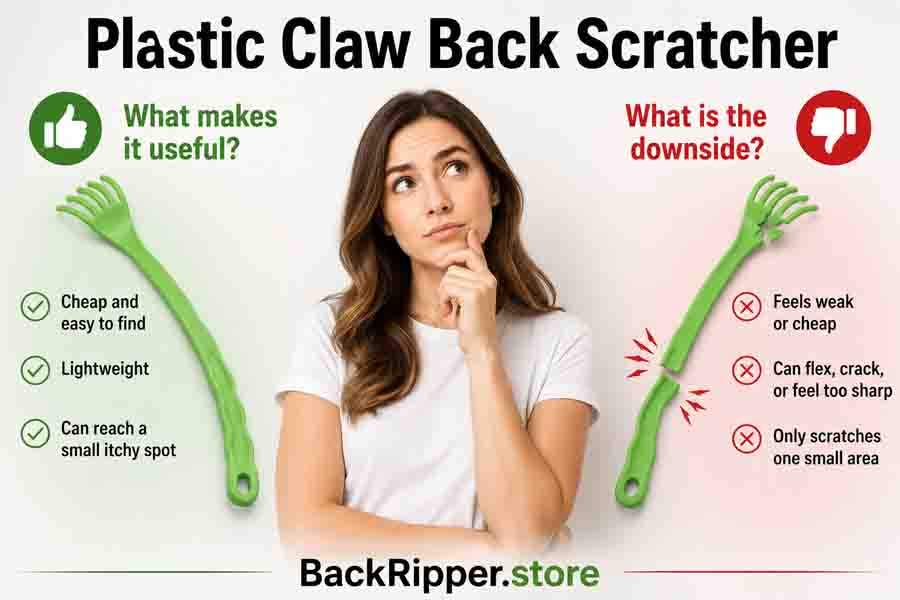
The biggest advantage is simplicity. You hold the handle with one hand, reach behind your body, and position the claw over the itchy area.
Plastic claws can work well when the itch is small and easy to pinpoint.
Advantages of a Plastic Claw Back Scratcher
- Usually inexpensive
- Lightweight
- Easy to understand and use
- Good for a small, localized itch
- Easy to store
Disadvantages of a Plastic Claw Back Scratcher
- Small scratching area
- Some models feel weak under stronger pressure
- Thin plastic can bend or break
- Requires one arm to reach behind the body
- May take many strokes to cover a large area
For an occasional light itch, a simple plastic claw may be perfectly adequate. For people who want strong scratching pressure or full-back coverage, other styles may be more effective.
Wooden and Bamboo Back Scratchers
Wooden and bamboo back scratchers are another traditional option. They normally use a long rigid handle with a carved or shaped scratching end.
Because wood is rigid, it can provide more direct scratching pressure than some lightweight plastic designs.
Bamboo models are also popular because they are simple, inexpensive, and do not require moving parts.
Advantages of Wooden Back Scratchers
- Rigid construction
- Simple design
- Often inexpensive
- Can provide firm scratching pressure
- No telescoping mechanism to wear out
Disadvantages of Wooden Back Scratchers
- Still uses a relatively small scratching head
- Rigid shape does not follow the curve of the body
- Requires one-handed reaching
- Some inexpensive models can splinter or crack
Wood and bamboo can be good options for someone who likes a traditional scratcher but wants something more rigid than thin plastic.
Telescoping Back Scratchers
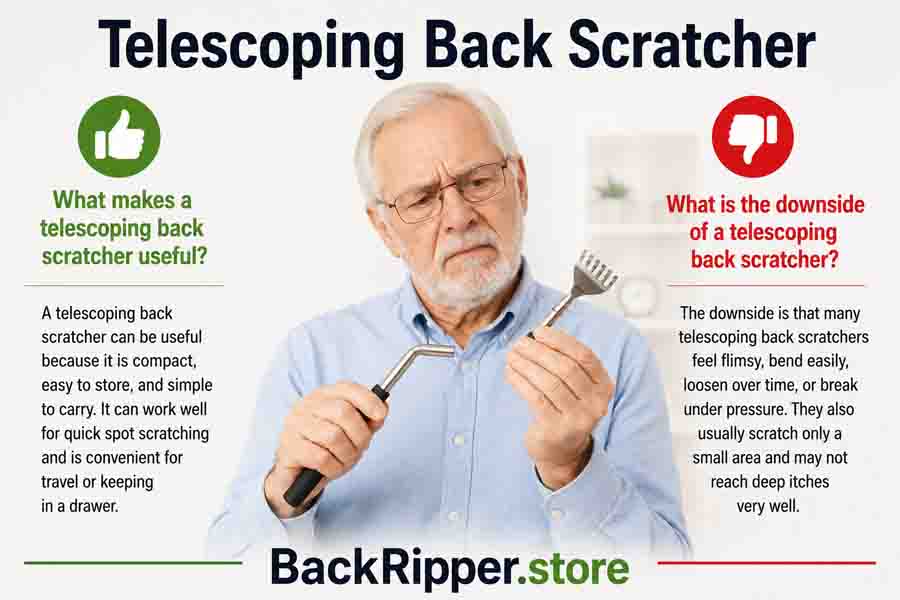
Telescoping back scratchers use a metal shaft that extends and collapses. They are popular because they can provide a lot of reach while taking up very little space when stored.
Many telescoping models have a small metal claw or plastic scratching head.
They can be convenient for travel, office use, or keeping in a drawer.
Advantages of Telescoping Back Scratchers
- Excellent reach
- Compact when collapsed
- Easy to carry or store
- Useful for targeting one specific itch
Disadvantages of Telescoping Back Scratchers
- Small scratching surface
- Thin telescoping sections may flex under pressure
- Moving sections can loosen over time
- Still requires one-handed control
A telescoping back scratcher is a good choice for someone who values portability and reach more than broad scratching coverage.
Brush-Style Back Scratchers
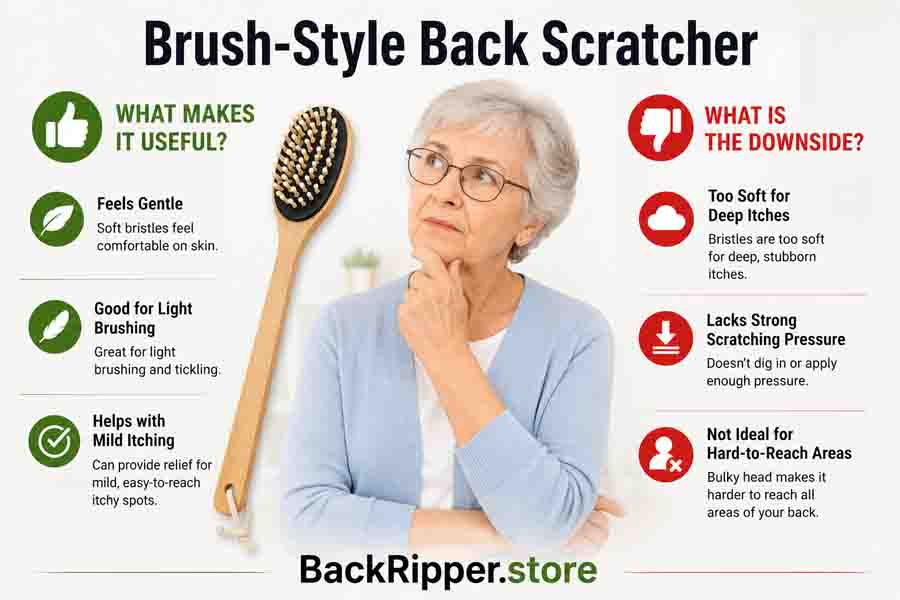
Brush-style back scratchers use bristles, rubber fingers, or a textured brush head instead of a traditional claw.
These designs usually provide a softer sensation than a rigid claw or aggressive scratching surface.
They can be useful for people who prefer gentle stimulation rather than a strong scratch.
Advantages of Brush-Style Back Scratchers
- Softer contact
- Can cover a wider area than a small claw
- May feel more comfortable on sensitive skin
- Some models can also be used for bathing or exfoliating
Disadvantages of Brush-Style Back Scratchers
- May feel too soft for a strong itch
- Bristles can flatten or wear down
- Less concentrated scratching pressure
- Some users want more aggressive contact
For people who dislike sharp or firm scratching pressure, a brush-style scratcher may be one of the better choices.
Flexible Two-Hand Strap Back Scratchers
A flexible strap back scratcher works differently from traditional stick-style designs.
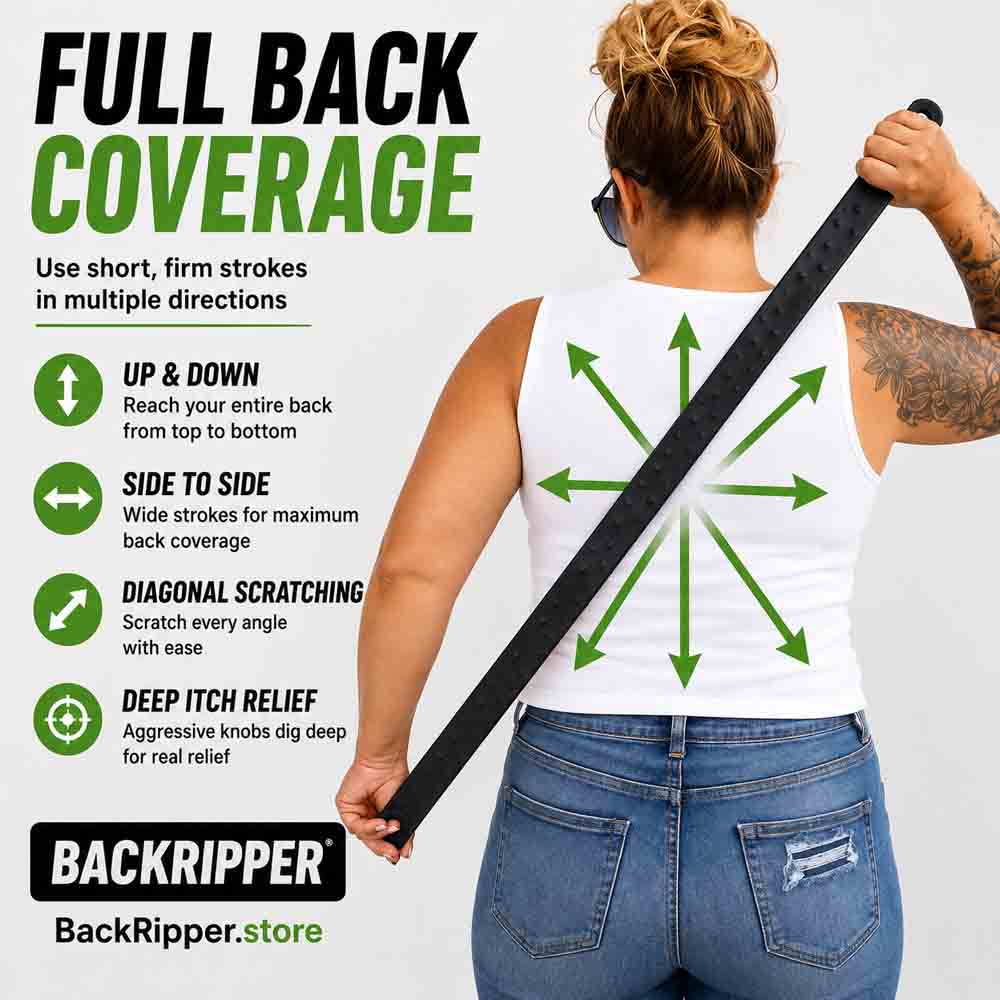
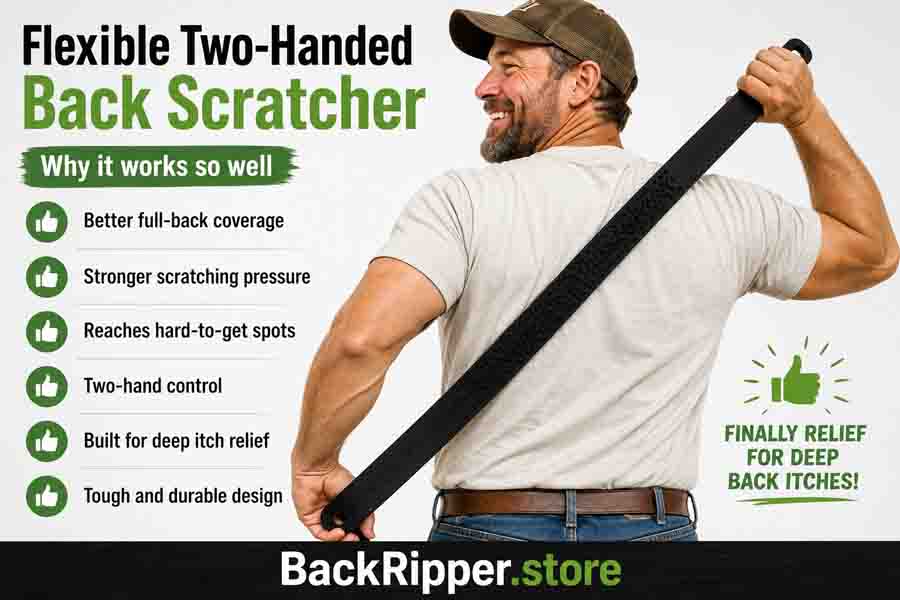
Instead of holding one long handle, you hold one end with each hand and pull the scratching surface across your back.
This allows the tool to follow the natural shape of the body while giving you control over pressure, direction, and speed.
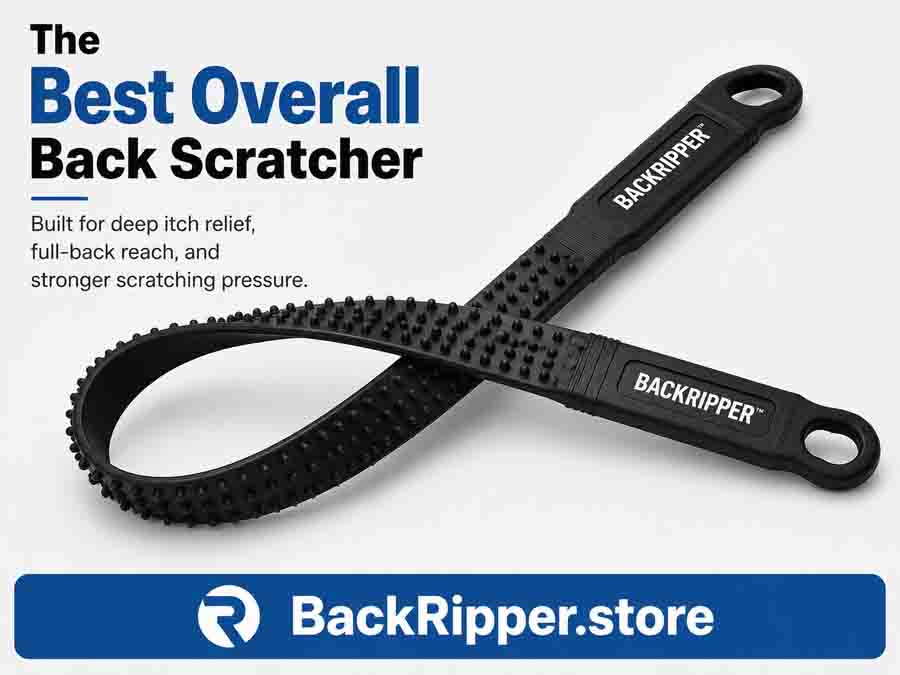
BackRipper™ uses this two-hand design with a flexible rubber strap and many firm raised scratching knobs.
Advantages of a Flexible Strap Back Scratcher
- Large scratching area
- Two-handed pressure control
- Can reach upper, middle, and lower back
- Works well with diagonal or side-to-side strokes
- Follows the natural curve of the body
- Good for people who prefer stronger scratching pressure
Disadvantages of a Flexible Strap Back Scratcher
- Larger than a telescoping scratcher
- Requires both hands during use
- May feel too aggressive for people who prefer very light scratching
For people who frequently experience hard-to-reach itching across a large portion of the back, a flexible two-hand strap may be the best type of back scratcher.
Which Type of Back Scratcher Gives the Strongest Scratch?
If scratching pressure is your main priority, the material and the way the tool transfers force to your back matter a lot.
Wooden scratchers can feel firm because they are rigid. Metal claw scratchers can also feel strong because their points do not compress easily.
A flexible strap can provide strong scratching pressure in a different way. Instead of pushing a small claw into the back, you create tension with both hands and pull a large scratching surface against the body.
This gives you direct control over how much pressure you use.
If you specifically want a stronger, more durable design, see our guide to choosing a heavy duty back scratcher.
What Is the Best Type of Back Scratcher for Full-Back Coverage?
For full-back coverage, a larger scratching surface usually has an advantage over a small claw.
A traditional stick-style back scratcher may be excellent for one itch, but it normally scratches only a small area at a time.
A flexible strap can move across a much larger portion of the back in each stroke.
You can use it:
- Vertically
- Horizontally
- Diagonally
- Around the shoulder blades
- Across the lower back
- Across the center of the back
That can make a strap-style design useful when the itching is spread across a wide area rather than one small spot.
What Is the Best Type of Back Scratcher for Elderly Users?
There is no single back scratcher that is ideal for every older adult because mobility and personal preference vary.
A lightweight stick-style back scratcher can be easy to hold and may work well for someone with good shoulder mobility.
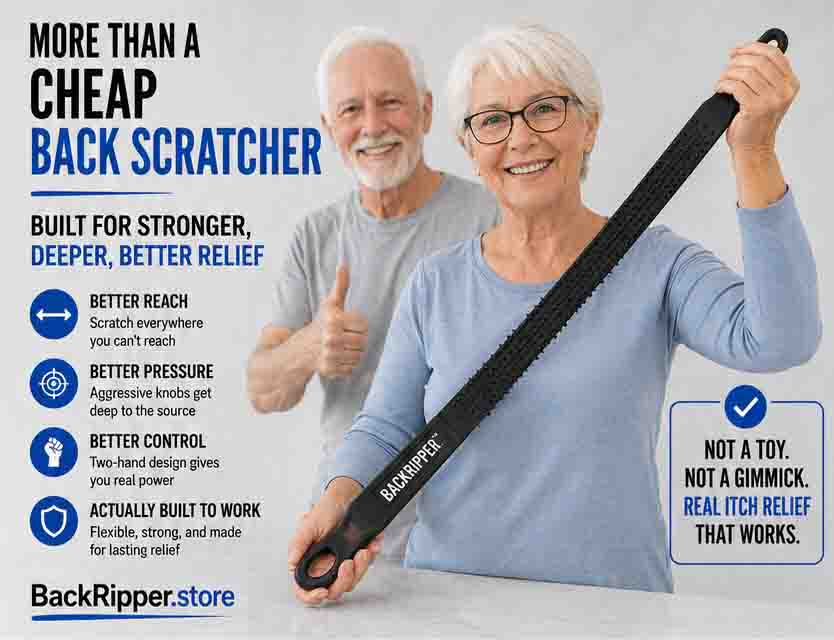
A two-hand strap may be useful for someone who finds it uncomfortable to rotate one arm far behind the body.
Instead of trying to place one small claw on an exact point, the user can position the strap behind the back and move it using both hands.
The best choice depends on grip strength, shoulder movement, desired scratching pressure, and whether the user prefers one-handed or two-handed operation.
What Is the Best Type of Back Scratcher for a Deep Itch?
People who describe an itch as deep often want stronger mechanical scratching pressure rather than a soft brushing sensation.
For this type of user, a lightweight brush may not feel strong enough.
Rigid wooden scratchers, firm claws, and heavy-duty strap designs can all create more noticeable contact.
However, stronger is not always better if the skin is already irritated.
The American Academy of Dermatology explains that repeated scratching can further irritate itchy skin. Start with moderate pressure and avoid scratching broken or inflamed skin aggressively.
Are Back Scratchers Good for You?
A back scratcher can provide temporary relief from an ordinary itch by helping you reach an area that your fingers cannot.
However, scratching does not treat the underlying cause of persistent itching.
Dry skin, irritation, allergies, skin conditions, and other factors can all contribute to itching.
The Mayo Clinic recommends seeking medical advice when itching is severe, unexplained, lasts for an extended period, or occurs with other symptoms.
A back scratcher should be viewed as a comfort tool, not as treatment for a medical condition.
Which Type of Back Scratcher Is Most Durable?
Durability depends on both the material and the construction.
A thick wooden scratcher can last for years. A well-made metal telescoping model may also last a long time if the joints remain tight.
Thin plastic models may be more likely to bend or crack if they are used with heavy pressure.
Flexible rubber designs can have an advantage because they are intended to bend repeatedly rather than resist bending entirely.
BackRipper™ was designed around that principle. The strap flexes with the body while the raised scratching knobs remain firm enough to provide effective contact.
How to Choose the Best Type of Back Scratcher
Instead of choosing a back scratcher based only on price or appearance, think about how you actually plan to use it.
Ask yourself:
- Do I want light or strong scratching pressure?
- Is my itch usually in one spot or across a large area?
- Can I comfortably reach behind my back with one arm?
- Do I want something compact for travel?
- Do I care more about price or long-term durability?
- Do I prefer a rigid scratching tool or a flexible one?
If you only need occasional light scratching, a simple plastic or wooden scratcher may be enough.
If portability is most important, a telescoping model can make sense.
If you prefer gentle contact, a brush-style design may be better.
If you want stronger pressure and broader coverage, a flexible two-hand strap can offer a very different experience.
Why BackRipper™ Makes Sense for Strong Full-Back Scratching
BackRipper™ was created for people who were frustrated with traditional back scratchers that felt too weak, covered too little area, or required awkward one-handed reaching.
Its design uses a flexible rubber strap with a large field of raised scratching knobs.
You hold one handle in each hand and control the pressure by changing the amount of tension on the strap.
This makes it possible to use short, firm strokes over one itch or longer strokes across a large portion of the back.
BackRipper™ is not necessarily the best choice for someone who wants a very soft scratch. It is designed more specifically for people who prefer strong, satisfying scratching pressure and full-back coverage.
Final Thoughts: Choosing the Best Type of Back Scratcher
The best type of back scratcher depends on what matters most to you.
A plastic claw is inexpensive and familiar. A wooden scratcher provides a simple rigid design. A telescoping scratcher offers excellent portability. A brush-style scratcher provides softer contact.
A flexible two-hand strap provides broad coverage and greater control over scratching pressure.
There is no single design that is perfect for every person, but understanding the differences makes it much easier to choose the right one for your back.
If you want strong scratching pressure, full-back reach, and a flexible design made for repeated use, BackRipper™ provides an alternative to traditional stick-style back scratchers.
BackRipper™ — The Back Scratcher That Actually Works.
What is the best type of back scratcher?
The best type of back scratcher depends on your preferred scratching pressure, reach, comfort, and coverage. Plastic claws, wooden scratchers, telescoping models, brushes, and flexible strap designs all offer different benefits.
What type of back scratcher gives the strongest scratching pressure?
Rigid wooden scratchers, firm claw-style scratchers, and heavy-duty flexible strap designs can all provide strong scratching pressure. A two-hand strap also lets you adjust pressure by increasing or reducing tension.
What is the best type of back scratcher for full-back coverage?
A flexible two-hand strap back scratcher is well suited for full-back coverage because it can move vertically, horizontally, and diagonally across the upper, middle, and lower back.
What is the best type of back scratcher for elderly users?
The best choice depends on mobility and grip strength. Some elderly users may prefer a lightweight stick-style scratcher, while others may find a two-hand strap easier because it reduces the need to reach one arm far behind the body.
Are telescoping back scratchers better than plastic claw back scratchers?
Telescoping back scratchers usually offer better reach and compact storage, while plastic claw back scratchers are simple and inexpensive. Both typically cover a smaller area than a flexible strap-style back scratcher.
Why choose BackRipper™ instead of a traditional back scratcher?
BackRipper™ uses a flexible two-hand rubber strap with many firm raised scratching knobs. It is designed for stronger scratching pressure, broader back coverage, and better control than many traditional one-hand stick-style scratchers.