
The best way to scratch your back is to use a tool that gives you enough reach, controlled pressure, and good coverage without forcing you to twist or strain. Traditional back scratchers can work well for one small itchy spot, but if you regularly struggle with hard-to-reach areas, a longer or two-handed back scratching tool can make the job much easier.
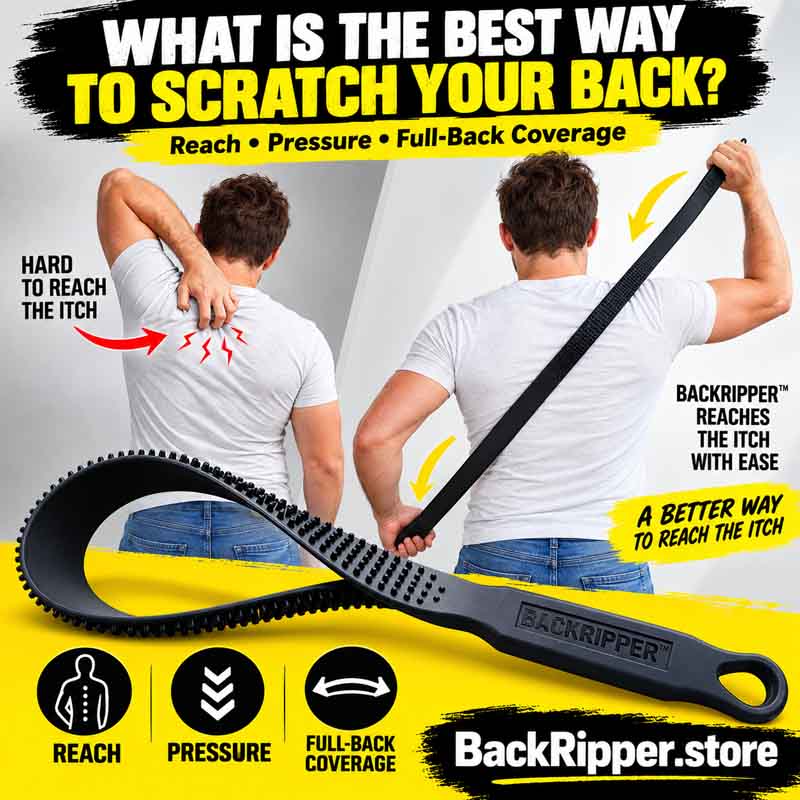
There is no single back scratcher design that is perfect for everyone. Some people prefer a simple telescoping claw, while others want stronger scratching pressure or a tool that can reach across a much larger area of the back.
If you are trying to decide which design is right for you, our guide to the 5 Best Back Scratchers compares several popular styles and explains the strengths and weaknesses of each.
Why Is Your Back So Hard to Scratch?
Your back is one of the most difficult areas of your body to reach with your own hands. An itch between the shoulder blades, along the middle of the back, or near the lower back can be especially frustrating because your arms simply do not bend far enough to comfortably reach every spot.
That is why back scratchers have existed in one form or another for generations. The basic idea is simple: extend your reach so you can scratch an area that your fingers cannot reach.
The problem is that different designs provide very different levels of pressure, coverage, and control.
Use a Back Scratcher Tool for Hard-to-Reach Areas
For most people, the easiest way to scratch a hard-to-reach area is with a dedicated back scratcher.
Common designs include:
- Telescoping metal back scratchers
- Plastic claw back scratchers
- Wooden or bamboo back scratchers
- Bear claw or rake-style scratchers
- Brush-style back scratchers
- Flexible two-hand back scratching straps
Each style works differently. A telescoping scratcher is compact and good for targeting one exact spot. A larger rake or claw can provide more contact points. A flexible two-hand design can cover a broader section of the back and lets you control pressure with both hands.
What Is the Best Way to Scratch the Middle of Your Back?
The middle of the back is usually the hardest area to reach because neither hand can comfortably reach it from above or below.
A long-handled back scratcher can solve the reach problem, but it still usually scratches only a small area at a time.
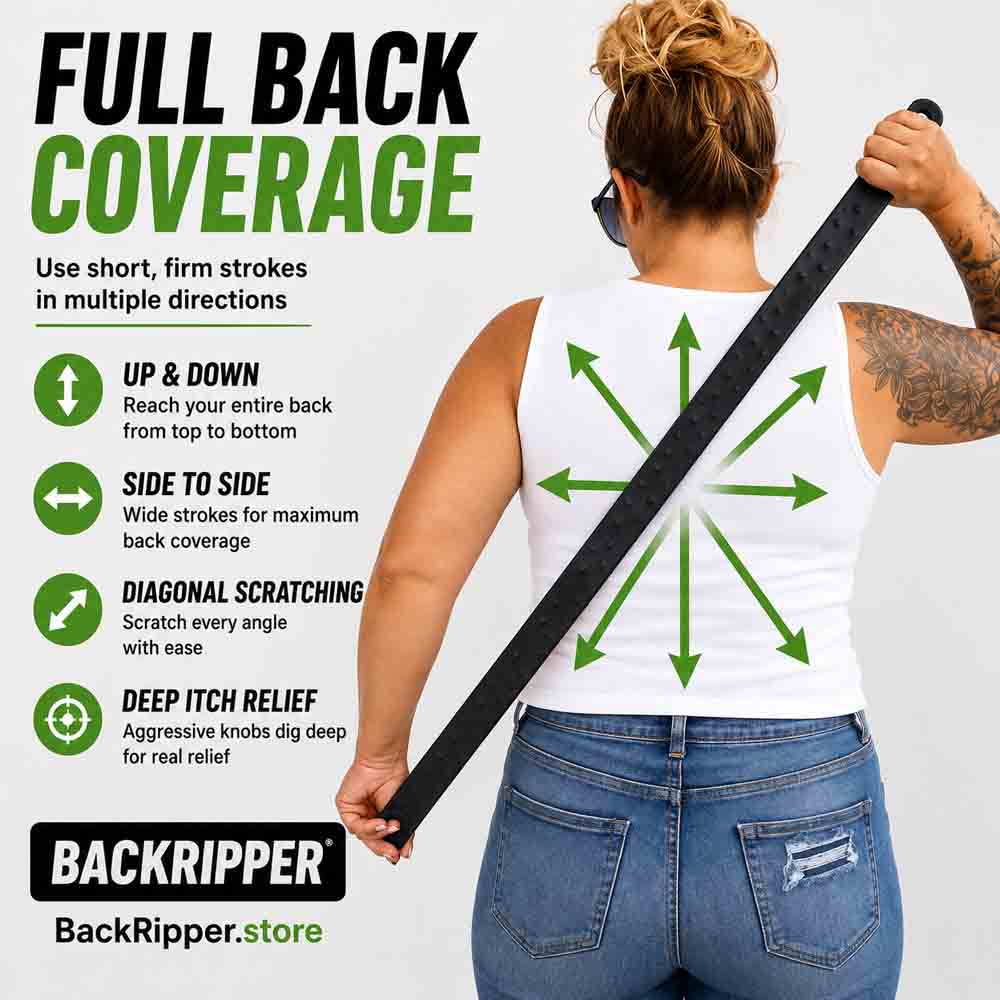
Another option is a flexible two-hand scratching strap. Instead of trying to aim a small claw at one spot, you hold one end in each hand and move the scratching surface across your back.
This lets you reach from the lower back to the shoulder blades while controlling the direction and amount of pressure yourself.
BackRipper™ was designed specifically around this two-hand approach. You can see how it works on our heavy duty back scratcher page.



What About Using a Towel or Shirt?
If you do not have a back scratcher nearby, people sometimes use household items such as a towel, shirt, or washcloth.
You can hold one end in each hand and move the fabric back and forth across your back. This can provide some temporary relief, especially if the itch is mild.
The downside is that normal fabric usually does not provide much concentrated scratching pressure. It rubs the area more than it actually scratches it.
For a stubborn itch, a purpose-built scratching surface generally gives you much better control.
Is a Telescoping Back Scratcher the Best Choice?
Telescoping back scratchers are popular because they are inexpensive, compact, and easy to store.
They are especially useful when you know exactly where the itch is and simply need a little extra reach.
However, most telescoping scratchers have a relatively small scratching head. That means you may spend more time trying to locate the exact itchy spot, especially when the itch moves or covers a larger portion of your back.
Thin telescoping shafts can also flex when heavier pressure is applied, depending on the quality of the scratcher.
What About Bear Claw and Rake Back Scratchers?
Bear claw and rake-style back scratchers use several prongs or scratching points instead of one small hook.
That larger scratching head can feel stronger than a traditional narrow back scratcher and may cover more area with each stroke.
They can be a good choice for someone who wants a rigid one-handed tool with a more aggressive scratching surface.
The tradeoff is that they still rely on a handle or shaft, so you are guiding the scratching head from one end of the tool.
A two-hand scratching strap works differently because you control the scratching surface from both ends.
What Is the Best Way to Scratch a Large Area of Your Back?
If your itch is spread across your upper, middle, or lower back rather than one tiny spot, a larger scratching surface can be much more efficient.
This is where a flexible back scratching strap has a major advantage.
Instead of repeatedly aiming a small claw at different locations, the strap can move diagonally or horizontally across a much larger section of your back.
You can also adjust the pressure simply by pulling harder or lighter with your hands.
That combination of reach, pressure control, and coverage is one of the reasons we developed the BackRipper™ back scratcher.
You can view the actual product here: BackRipper™ Back Scratcher.
How Hard Should You Scratch Your Back?
A satisfying scratch does not mean you should damage your skin.
Scratching too aggressively can irritate the skin or make an existing skin problem worse. The American Academy of Dermatology recommends avoiding repeated scratching when possible because persistent scratching can further irritate itchy skin. You can read their guidance on relieving itchy skin.
The goal should be enough pressure to satisfy the itch without scraping, cutting, or breaking the skin.
If a back scratcher leaves painful marks or broken skin, you are using too much pressure.
Why Does Scratching Feel So Good?
Scratching temporarily interrupts the sensation of itching, which is why it can feel so satisfying.
The problem is that repeated scratching can sometimes create an itch-scratch cycle where irritated skin becomes even itchier.
If the itch keeps returning, the better long-term solution may be figuring out why your skin is itching rather than simply scratching harder.
Dry Skin Is a Common Cause of Back Itching
Dry skin is one of the most common reasons people experience persistent itching.
The back can be especially troublesome because it is difficult to apply moisturizer evenly without help.
The American Academy of Dermatology notes that very dry skin can become intensely itchy, and persistent scratching can further irritate the skin. :chatgpt-content-reference{index=”1″}
Mayo Clinic also recommends paying attention to persistent or unexplained itching rather than assuming every itch simply needs to be scratched.
If you have ongoing itching, a rash, broken skin, bleeding, swelling, or an itch that does not improve, consider talking with a healthcare professional.
Is It Better to Scratch With One Hand or Two?
One-handed back scratchers are convenient and work well for targeted scratching.
Two-handed designs give you a different type of control.
With one hand on each end of the scratching tool, you can control:
- Pressure
- Direction
- Speed
- Angle
- Coverage
This can be particularly useful for people who want stronger scratching pressure or need to reach the entire middle of their back.
What Is the Best Back Scratcher for Strong Itches?
If you prefer stronger scratching pressure, look for a back scratcher that has a firm scratching surface and allows you to control how much force is applied.
Small plastic claws and thin telescoping tools may be enough for light itching, but people who prefer a deeper scratch often look for heavier-duty designs.
A flexible two-hand back scratcher can provide strong pressure because both arms are helping control the tool rather than relying on one wrist and a long handle.
What Is the Best Back Scratcher for Full-Back Coverage?
For full-back coverage, look for a design that can reach from one side of your back to the other without requiring extreme shoulder movement.
A long flexible strap is particularly effective because it can wrap naturally around the body.
You can move it diagonally from your lower back toward the opposite shoulder, horizontally across the middle of your back, or vertically depending on where the itch is located.
This allows you to scratch areas that can be difficult to reach with traditional stick-style tools.
Should You Scratch an Itch That Keeps Coming Back?
An occasional itch is normal. A persistent itch can have many causes, including dry skin, irritation, allergies, skin conditions, insect bites, or other medical issues.
The American Academy of Dermatology explains that persistent itching can have many possible causes and recommends finding the underlying cause when itching does not go away. Learn more about itchy skin from the American Academy of Dermatology.
A back scratcher is a tool for scratching an ordinary itch. It is not a treatment for an underlying skin condition.
So, What Is the Best Way to Scratch Your Back?
The best way to scratch your back depends on the kind of itch you are trying to reach.
If you have one small itch and want something portable, a telescoping or claw-style back scratcher may work perfectly well.
If you want stronger pressure and broader coverage, a heavy-duty or rake-style scratcher may be a better choice.
If you regularly struggle to reach the middle of your back or want to scratch a much larger area at once, a flexible two-hand back scratching strap offers a different approach.
BackRipper™ was designed around that idea: strong scratching pressure, broad coverage, and control from both hands.
There is no need to rely on one design for every person or every itch. The best back scratcher is the one that gives you the reach, pressure, coverage, and control you prefer.
Frequently Asked Questions
What is the easiest way to scratch your own back?
The easiest way is usually to use a back scratcher that extends your reach without requiring you to twist your shoulders. Telescoping scratchers work well for small areas, while two-hand scratching straps can reach a much larger section of the back.
How do you scratch the middle of your back?
You can use a long-handled back scratcher or a flexible two-hand scratching strap. A strap can be particularly useful because it can move diagonally across the middle of your back while both hands control the pressure.
What can I use if I do not have a back scratcher?
A towel, shirt, or washcloth can be pulled across the back for temporary relief. These alternatives usually provide more rubbing than scratching but can work for a mild itch.
Is it bad to scratch your back too hard?
Yes. Scratching hard enough to damage or break the skin can cause irritation and increase the risk of further problems. Use controlled pressure and stop if scratching becomes painful.
What type of back scratcher gives the strongest scratch?
People looking for stronger pressure often prefer rigid rake-style scratchers, firm claw designs, or heavy-duty two-hand scratching straps. The best choice depends on whether you prefer targeted scratching or broad coverage.
What is the best way to scratch a hard-to-reach back itch?
Use a back scratcher that gives you enough reach without forcing your shoulders into an uncomfortable position. For large or difficult-to-reach areas, a flexible two-hand scratching strap can provide strong pressure and full-back coverage.